
Washington's latest defense doctrine signals a fundamental shift from global interventionism to interest-based security.
The United States Department of Defense has released its 2026 National Defense Strategy, a document that represents one of the most significant reorientations of American military policy since the end of the Cold War. Developed under the Trump administration, the strategy abandons decades of interventionist doctrine in favor of what it calls "common sense realism" — a framework that prioritizes direct threats to American interests over broader global commitments.
The strategy opens with an assessment of recent American foreign policy. For three decades, the document argues, Washington pursued nation-building projects, maintained costly overseas commitments, and allowed critical industries to migrate abroad — all while strategic competitors strengthened their positions. The result, according to Pentagon planners, is a world facing the risk of simultaneous large-scale conflicts across multiple theaters.
"We can no longer afford to be everywhere, doing everything, for everyone," the strategy states, marking a clear departure from the universalist rhetoric that has characterized American defense policy since 1991.
The new approach rests on three core principles:
America First, which places U.S. national interests above abstract global commitments;

Peace Through Strength, emphasizing overwhelming military power as the foundation of stability;
and Common Sense Realism, which calls for threat assessment based on concrete interests rather than ideological frameworks.
Perhaps most notably, the strategy elevates homeland defense to the top priority for the first time in decades. Threats to U.S. territory—including illegal migration, narco-terrorism, cyber warfare, drone technology, and missile systems—now receive equal billing with traditional military competitors.

The document places special emphasis on strategic locations in the Western Hemisphere: the Panama Canal, Greenland, the Arctic region, and what it terms the "Gulf of America" (Gulf of Mexico). This approach, described as the "Trump Corollary to the Monroe Doctrine," reasserts American dominance in its immediate geographic sphere.
China emerges as the central strategic challenge.
The strategy characterizes Beijing as the most significant long-term rival the United States has faced in over a century, citing China's massive military investment, rapid modernization of the People's Liberation Army, and growing influence over Indo-Pacific trade routes.
However, the stated objective is not regime change but denial — preventing any power from achieving dominance over the United States or its allies. The strategy calls for building robust defensive capabilities along the First Island Chain and applying "deterrence by denial" to make Chinese aggression militarily futile.
On Russia, the strategy takes a notably different tone than previous Pentagon documents.

While acknowledging Moscow as a regional military threat to Eastern Europe and a global nuclear power with advanced cyber and space capabilities, the strategy emphasizes that NATO's collective economy vastly exceeds Russia's and that Europe possesses sufficient resources for its own defense.
The implication is clear: European nations must assume primary responsibility for their own security, allowing the United States to shift focus toward the Indo-Pacific and homeland defense.
In the Middle East, the strategy claims that recent U.S. military operations have effectively destroyed Iran's nuclear program and severely weakened Hamas, Hezbollah, and the Houthis. The American approach now centers on empowering Israel, strengthening partnerships with Gulf states, and expanding the Abraham Accords framework rather than maintaining large-scale U.S. military presence.

North Korea is characterized as a direct nuclear threat to South Korea, Japan, and potentially the U.S. homeland, but the strategy argues that Seoul must take the lead role in deterrence with limited American support.
A central feature of the new strategy is its proposal for a global defense spending benchmark: 5% of GDP, split between 3.5% for core military capabilities and 1.5% for security-related costs. This standard is intended to apply not only to NATO members but to allies worldwide.

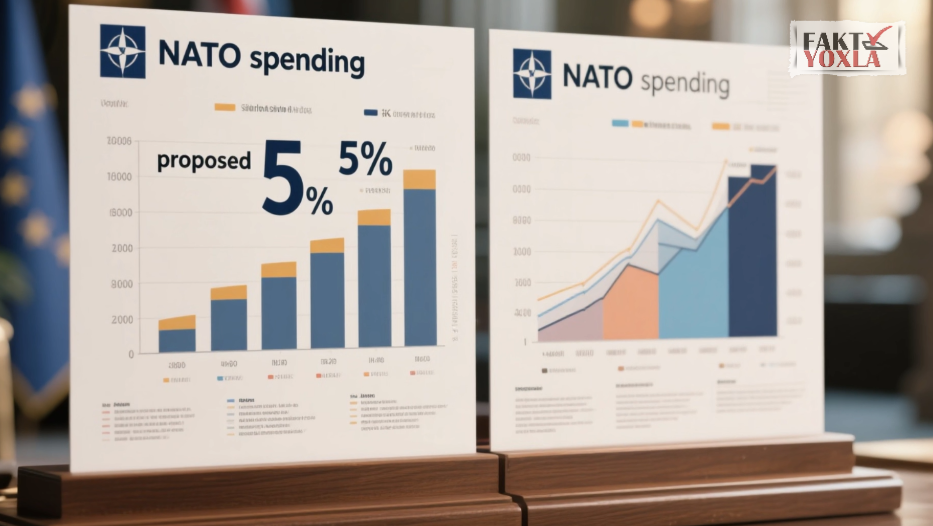
The message accompanying this proposal is unambiguous: the United States will no longer subsidize the security of wealthy nations that can afford to defend themselves. This represents a significant escalation from NATO's current 2% target and would require substantial increases in defense spending across Europe and Asia.
The strategy organizes American defense efforts into four main priorities:
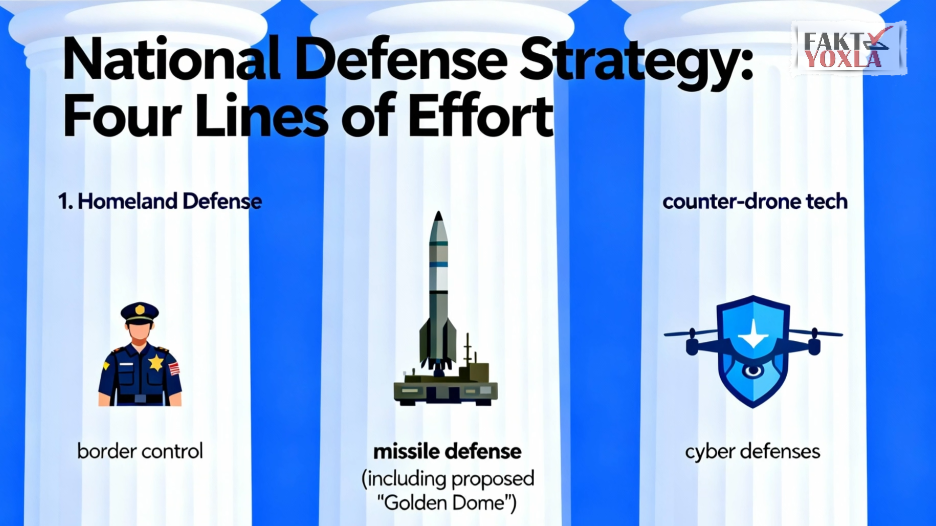
Homeland Defense includes border control measures, missile defense systems (including the proposed "Golden Dome" architecture), counter-drone capabilities, nuclear modernization, and enhanced cyber defenses.
China Deterrence focuses on maintaining military superiority in the Indo-Pacific through advanced capabilities, strengthened regional alliances, and strategic communications backed by credible force.
Burden Redistribution calls for Europe to handle European security, Middle Eastern partners to lead in that region, South Korea to take primary responsibility for the Korean Peninsula, and limited U.S. counterterrorism engagement in Africa.
Industrial Revitalization announces what amounts to national industrial mobilization, including reshoring defense production, prioritizing artificial intelligence and emerging technologies, and accelerating weapons manufacturing to transform America into the "arsenal of the 21st century."

A key strategic concept in the document is the "simultaneity problem"—the risk that the United States could face multiple major conflicts at once across different regions. The proposed solution shifts the burden: allies must transition from dependents to full contributors in collective defense arrangements.
This approach represents a fundamental restructuring of the alliance system that has underpinned American global strategy since World War II. Rather than forward-deployed U.S. forces serving as the primary deterrent, regional partners would assume that role with American support playing a secondary function.

The strategy's concluding sections make explicit what has been implicit throughout: the United States is offering the world a transactional relationship. Washington seeks neither universal domination nor moral leadership of the international system. Instead, it promises zero tolerance for threats to American interests and readiness to use decisive force when necessary, but no longer frames this in terms of broader ideological or humanitarian missions.
"Peace is only possible when America is strong," the document states. "Strength is not for conquest, but for deterrence."

The 2026 National Defense Strategy raises significant questions about the future of American power and global stability.

Supporters contend that the strategy represents overdue realism about American limits and allied responsibilities. They argue that the post-Cold War model of American global engagement has proven unsustainable and that clarifying priorities is essential for maintaining long-term military superiority where it matters most.
The strategy's success will likely depend on whether allies interpret burden-sharing as an opportunity for greater autonomy or as American abandonment. It will also depend on whether potential adversaries view the new approach as credible deterrence or as an invitation to test American resolve in areas now designated as lower priorities.

What is certain is that the 2026 National Defense Strategy marks a clear inflection point. Whether it represents wise adaptation to changed circumstances or a dangerous retreat from global leadership remains to be seen.