

Binance: What Happened and Why Does It Matter?
On October 29, 2026, Binance, the world's largest cryptocurrency exchange, reported a major security incident. According to the company, attackers had managed to carry out unauthorized withdrawals from hot wallets — digital wallets connected to the internet.
The preliminary losses were estimated at approximately $6.3 billion. This would make it one of the largest, and according to some estimates, the largest cryptocurrency hacks in history.
What Do We Know So Far?
The attack affected Binance's infrastructure responsible for processing cryptocurrency transactions. According to the company's initial assessment, the attackers may have gained access to the system through a compromised laptop belonging to an employee. Binance later reported that its investigation had identified additional potential points of entry.
At the same time, the exchange stated that there was no evidence that private keys associated with cryptocurrency wallets had been leaked.
Following the incident, approximately $3 billion worth of assets linked to the attack were frozen. This was made possible through cooperation between Binance, its partners, and stablecoin issuers.
The company also assured users that the financial losses would be covered using its own funds and its Secure Asset Fund for Users (SAFU).
As of November 2, the company reported that approximately 95% of the stolen assets had been recovered, while customer withdrawals were gradually being restored. However, the investigation was still ongoing, and information about the total amount recovered and the details of the attack could be subject to further updates.
What Does This Incident Prove — and What Does It Not?
The incident does not mean that all cryptocurrencies or blockchain technology itself have been hacked. Rather, it demonstrates that even the largest centralized exchanges can be vulnerable due to infrastructure failures, compromised employee access, or weaknesses in security systems.
There is also a broader lesson: when someone stores cryptocurrency on an exchange, they depend not only on the value of the asset but also on the reliability of the platform itself.
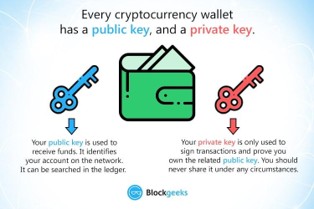
This is an important distinction from self-custody, where users control their own private keys but are also personally responsible for keeping them secure.
What Is Cryptocurrency?
Cryptocurrency is a digital asset that is created, transferred, and recorded using cryptographic methods and specialized computer networks. Unlike traditional money, many cryptocurrencies are not issued by central banks and do not have a single issuer guaranteeing their value.
Blockchain technology is the foundation of many cryptocurrencies.




How Does Blockchain Work?
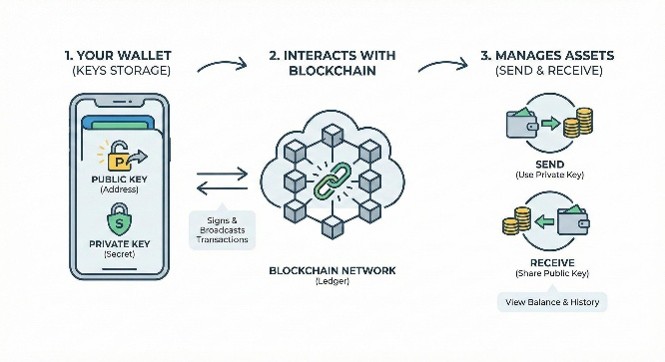
Imagine a shared digital ledger, with copies stored on numerous computers. When someone sends cryptocurrency, the network verifies the transaction and records it in the ledger. These records are grouped into blocks, which are cryptographically linked to one another.
This system allows network participants to verify transactions without relying on a single central administrator. However, blockchain does not guarantee that a cryptocurrency will increase in value, that an exchange will not go bankrupt, or that users will never lose access to their funds.
What Types of Cryptocurrencies Are There?
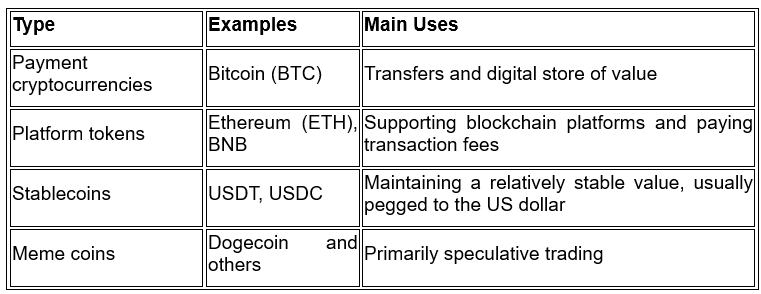
It is important to understand that a stablecoin is not the same as a bank deposit. Even if a token is pegged to the US dollar, its market price may deviate from $1. The ability to exchange it for traditional currency also depends on the issuer, reserves, and available financial infrastructure.
How Do People Buy Cryptocurrency?
One of the most common ways to buy cryptocurrency is through an exchange such as Binance. These platforms allow users to buy, sell, and exchange digital assets.
The process generally involves several steps:
- Registration and identity verification. Users create an account and complete identity verification if required by the platform.
- Depositing funds. Money can be added using available payment methods, such as bank transfers, cards, or supported peer-to-peer (P2P) services.
- Buying an asset. Users select the cryptocurrency they want to purchase and specify the amount. For example, it is possible to buy a small fraction of a Bitcoin rather than an entire coin.
- Holding or selling. The purchased asset can be kept on the exchange, exchanged for another cryptocurrency, or transferred to a personal wallet.
Binance offers simplified conversion services and spot trading. A spot purchase means that users acquire the actual asset rather than speculating on its price movements using leverage. For beginners, this is easier to understand and generally less risky than futures or margin trading.
How Much Money Do You Need to Get Started?
Technically, it is possible to start with a relatively small amount. On some cryptocurrency platforms, for example, the minimum Bitcoin purchase may be just a few dollars. The exact minimum depends on the exchange, trading pair, payment method, and applicable fees.
However, the minimum purchase amount and a reasonable investment amount are not necessarily the same thing.
For someone who is just learning about the market, making a small test purchase can help them understand how orders, fees, storage, and withdrawals work. However, money needed for everyday expenses, debt repayments, or an emergency fund should not be invested.
The main rule is simple: only invest an amount you could afford to lose entirely without seriously affecting your financial well-being.
How Do Investors Make a Profit?
Cryptocurrency does not generate guaranteed returns. In most cases, investors make a profit by selling an asset at a higher price than they paid for it.
For example, someone purchases $100 worth of Bitcoin.
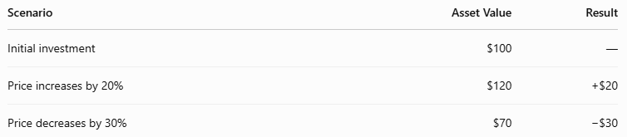
This is a simplified example. In reality, the final result also depends on transaction fees, spreads, taxes, and the exchange rate at the time of sale.
Is It Possible to Earn Passive Income?
Some platforms offer additional ways to generate returns:
- Staking — participating in the operation and security of certain blockchain networks in exchange for rewards.
- Crypto lending — lending digital assets to other market participants in return for interest.
- Exchange yield products — placing cryptocurrency into programs offered by platforms that promise a certain return.
However, these products are not equivalent to bank deposits with guaranteed repayment. Rewards may be paid in tokens whose market value can decline. There are also risks involving frozen funds, protocol hacks, and the bankruptcy of intermediaries.
What Are the Main Risks?
- Sudden price declines. Cryptocurrency prices can fall by tens of percent within a short period. Some tokens lose almost all of their value.
- Exchange hacks. Even if a company promises to compensate users for losses, as Binance has done, such compensation should not be considered a universal guarantee offered by all platforms.
- Loss of wallet access. Losing a private key or seed phrase can result in the permanent loss of funds.
- Fraud and scams. Fake investment platforms, counterfeit applications, promises of guaranteed returns, and schemes offering to "double" cryptocurrency are common threats.
- Transfer errors. Sending funds to the wrong address or through an unsupported network is usually irreversible.
- Regulatory and tax risks. Rules governing cryptocurrency exchanges and taxation differ from country to country and may change over time.
Financial regulators warn that cryptocurrency investments can result in the loss of the entire amount invested.
To reduce these risks, beginners should consider starting with spot purchases and avoiding leveraged trading. They should not invest money intended for everyday expenses or make financial decisions under the influence of market hype and promises of quick profits.
Security also deserves particular attention. Investors should use strong, unique passwords, enable two-factor authentication, remain cautious of phishing websites, and never share their private keys or wallet seed phrases with anyone.
Before making a purchase, it is also important to understand the fees charged for transactions and withdrawals. If the amount invested becomes substantial, keeping all assets on a single exchange is generally not advisable.
It is worth remembering that self-custody gives users greater control over their funds but also makes them fully responsible for their security. Keeping cryptocurrency on an exchange, on the other hand, means trusting a third-party platform that may be exposed to technical failures, cyberattacks, and other problems.
What Should Residents of Azerbaijan Know?
Anyone planning to buy or sell cryptocurrency in Azerbaijan should consider not only price fluctuations and the risk of losing their investment but also their potential tax obligations.
According to explanations published by the State Tax Service of Azerbaijan, income earned by individuals from cryptocurrency transactions may be classified as income from non-commercial activity and subject to personal income tax at a rate of 14%.
This means that making a profit from selling cryptocurrency may create a tax liability. The taxable amount is not necessarily the entire sum received from the sale but rather the income earned — that is, the difference between the asset's purchase price and its selling price, subject to the applicable tax rules.
The tax authority's guidance also refers to the need to register as a taxpayer, obtain a taxpayer identification number (VÖEN), maintain records of income and expenses, and submit the relevant tax return. The stated deadline for filing is March 31 of the year following the reporting year.
In other words, cryptocurrency transactions are not automatically exempt from tax obligations simply because they take place online or through a foreign exchange. Investors should keep records of purchases and sales, transaction fees, and transaction histories to be able to demonstrate the origin of their funds and the amount of profit earned if required.
It is also important to remember that tax legislation may change, and the applicable tax treatment depends on the nature of the transactions and the taxpayer's individual circumstances. Before engaging in active trading or investing substantial amounts, it is advisable to seek clarification from the State Tax Service of Azerbaijan or consult a qualified tax professional.
Cryptocurrency and Illegal Financial Transactions: The Other Side of Digital Transfers
When discussing the risks of the cryptocurrency market, another serious issue cannot be overlooked: the use of digital assets for illegal financial activities, including money laundering and the financing of criminal organizations and terrorist groups.
Cryptocurrencies allow funds to be transferred between users, including those located in different countries, without the involvement of traditional banking intermediaries. In certain cases, criminals exploit this feature to conceal the origin of funds and move illegally obtained money.
At the same time, it is important to understand that cryptocurrency is not inherently anonymous. For example, most transactions on the Bitcoin network are recorded on a publicly accessible blockchain. This means that the movement of funds can be tracked, although identifying the individual behind a particular wallet may be difficult without additional information.
International organizations, particularly the Financial Action Task Force (FATF), have repeatedly warned about the use of virtual assets for money laundering, terrorist financing, and the circumvention of financial restrictions.
It would also be incorrect to claim that all cryptocurrency transfers are anonymous or impossible to monitor. On the contrary, transactions on public blockchains leave a digital trail that can be analyzed by specialized companies and law enforcement agencies. Challenges arise when unregulated wallets, multiple intermediaries, and tools designed to make the movement of funds harder to trace are involved.
The FATF's 2025 report specifically highlights the use of crypto assets, including stablecoins, in money laundering and terrorist financing. Similar risks are also addressed in United Nations publications.
To combat these activities, international organizations require cryptocurrency exchanges and other virtual asset service providers to verify customer identities, monitor suspicious transactions, and cooperate with financial regulators. However, implementation of these requirements varies from country to country, leaving opportunities for the illegal use of digital assets.
Ultimately, cryptocurrencies can be used for legitimate financial transactions as well as for moving illegally obtained funds. This is another important factor to consider when assessing the risks of the cryptocurrency market.
Final Fact-Check: What Should Investors Take Away?
Cryptocurrency is a modern financial instrument that creates new opportunities for investment, international transfers, and digital payments. However, these opportunities come with significant risks: high price volatility, the possibility of losing invested funds, cyberattacks targeting trading platforms, fraudulent schemes, and the use of digital assets for illegal financial activities, including the financing of criminal and terrorist organizations.
The Binance incident clearly demonstrates that even the largest cryptocurrency exchanges, with billions of dollars in reserves, are not immune to serious cyberattacks and technical failures. Meanwhile, the ability to move funds across borders without traditional banking intermediaries raises additional concerns for financial regulators and law enforcement agencies.
For these reasons, cryptocurrency should not be viewed solely as a way to make money or as an easy opportunity to grow one's wealth. Before investing, it is essential to understand how the market works, assess potential returns, learn how funds can be protected, and recognize that it is possible to lose not just part, but the entire amount invested.