

In many cultures, it is traditionally believed that sons are the ones who carry on the family line: they inherit their father’s surname, pass it on to their children and preserve the family name for future generations. But genetics tells a more interesting story. There is a special type of DNA that is inherited almost exclusively from the mother. Both boys and girls receive it, but, as a rule, only women pass it on to the next generation. This is mitochondrial DNA. So, from a biological perspective, who really carries on the family line?
Most of a person’s genetic information is stored in the cell nucleus. A child inherits roughly half of their nuclear DNA from their mother and half from their father. This applies regardless of the child’s sex: both sons and daughters inherit genes from both parents and pass on part of that genetic material to their own children.
However, cells contain another source of genetic information: mitochondria. These small structures play an essential role in producing the energy the body needs to function. They also have their own DNA, known as mitochondrial DNA, or mtDNA.
Unlike nuclear DNA, mitochondrial DNA is inherited almost exclusively through the maternal line. This distinctive feature has made it an important subject in research into human ancestry and evolution.
During fertilisation, the egg and sperm make different contributions to the developing embryo. The sperm provides the father’s nuclear DNA, while the egg contributes not only the mother’s genetic material but also the cytoplasm, which contains mitochondria.
The mitochondria from the sperm generally do not contribute to the embryo’s inherited mitochondrial DNA. As a result, a child’s mitochondrial DNA almost always comes from the mother.
Scientists are still investigating the precise mechanisms behind this process. A study published in "Nature Genetics" in 2023 helped explain why mature human sperm cells lack an intact mitochondrial genome. Researchers linked this finding to the activity of a protein called TFAM, which plays a role in maintaining mitochondrial DNA.
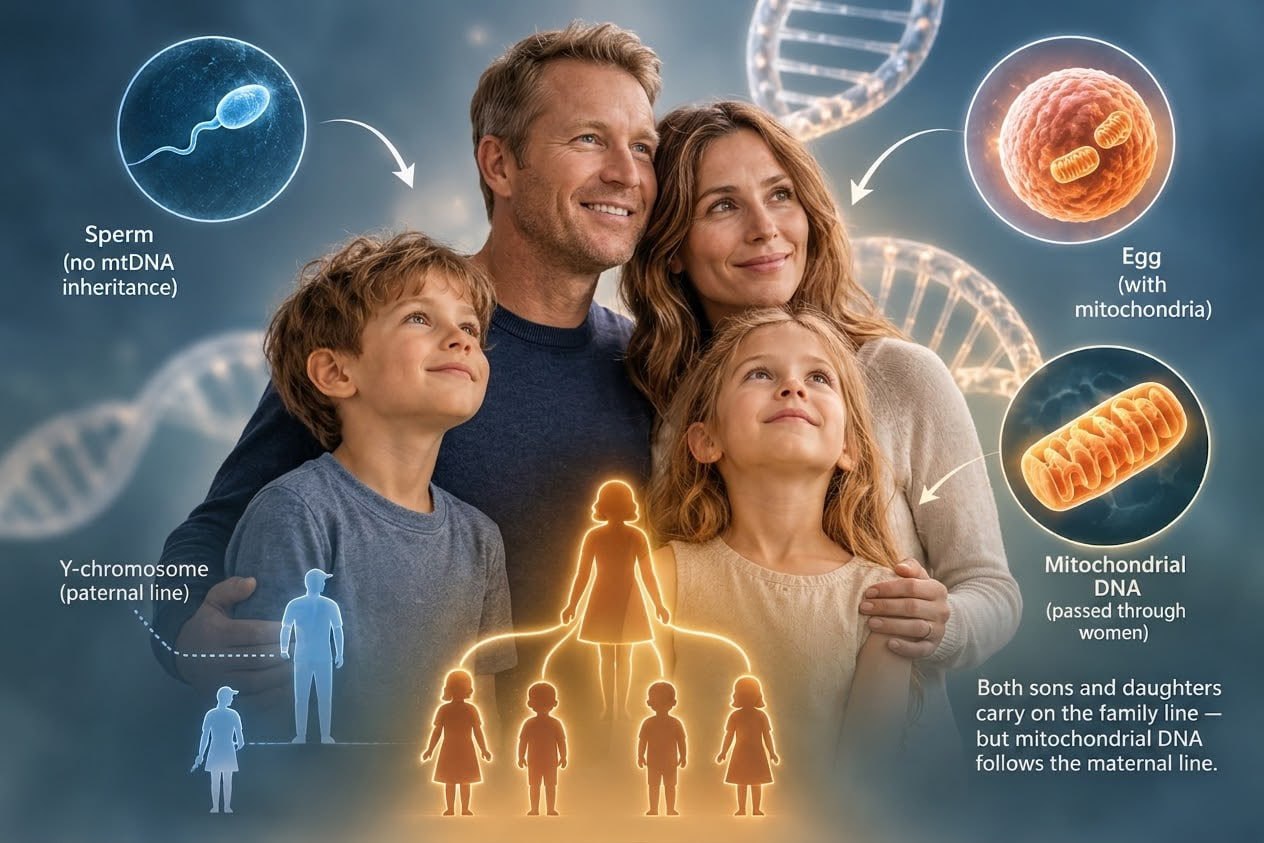
The most interesting part is that boys and girls inherit mitochondrial DNA in exactly the same way. A son receives it from his mother just as a daughter does. The difference becomes apparent later, when they have children of their own.
A woman passes her mitochondrial DNA to all her children, regardless of their sex. A man, however, generally does not pass his mitochondrial DNA on to his offspring.
Imagine a woman has both a son and a daughter. Both inherit her mitochondrial DNA. When her son becomes a father, his children will receive their mitochondrial DNA from their mother. His daughter, however, can pass that same maternal genetic line on to her own children.
This is why scientists studying mitochondrial DNA trace inheritance from mothers to their children and then through daughters to subsequent generations. A son remains a carrier of his mother’s mitochondrial DNA, but he does not normally continue its transmission.
The ability to trace maternal genetic lineages across thousands of generations has given rise to one of the best-known concepts in genetics: Mitochondrial Eve.
This term refers to the most recent woman from whom all living humans descend through an unbroken maternal line. Researchers estimate that she lived in Africa approximately 150,000–200,000 years ago.
However, this does not mean she was the first woman on Earth or the only woman alive at the time. Many other women lived during that period and had children of their own. Their maternal lineages simply did not survive continuously to the present day. For example, a maternal line could end in a generation in which a woman had only sons, since they would not pass her mitochondrial DNA on to their children.
Mitochondrial Eve’s maternal lineage, by contrast, has survived to the present day. This concept helps scientists investigate the origins of modern populations, ancient human migrations and genetic relationships between different groups.
If we look exclusively at mitochondrial DNA, the answer does favour the maternal line. Women are responsible for passing it from one generation to the next. However, it would be scientifically inaccurate to conclude that only daughters carry on the family line, while sons have no role in preserving a family’s genetic heritage.
Nuclear DNA is passed on by both men and women. Every child inherits genetic material from both parents and, in turn, passes some of it on to their own descendants. There is also a paternal genetic lineage that can be traced through the Y chromosome, which is passed from father to son.
Ultimately, genetics does not favour one sex over the other. It simply shows that different parts of our genetic inheritance follow different patterns of transmission.
In other words, both sons and daughters carry on the genetic lineage by passing nuclear DNA to their descendants. But when it comes specifically to mitochondrial DNA, women are the ones who maintain its continuity across generations. This is the key difference between the traditional social understanding of carrying on a family line and the way genetic inheritance actually works.