

Joey Esposito
The supposed "strange signals" were not mysterious at all, but commonly observed transit signals, according to NASA

Scientists using NASA's Transiting Exoplanet Survey Satellite discovered an exoplanet, which NASA defines as any planet beyond our solar system.
However, the "strange signals" turn of phrase came from reports and social media posts about the discovery, not NASA or the researchers involved. The alleged "strange signals" are actually commonly observed transit signals, which "reveal an exoplanet not because we directly see it from many light-years away, but because the planet passing in front of its star ever so slightly dims its light," according to NASA.
A rumor circulating on social media in January 2026 claimed that scientists had discovered a "super-Earth" outside our solar system.
One post on X alleged that the so-called super-Earth, named TOI-1846b, was 154 light-years away and emitting "mysterious, repeating" signals.
The claim echoed similar rumors from July 2025, such as an Instagram post (archived) that offered more details about the purported discovery, including that the planet was "about twice the size of Earth" and that it was made using NASA's Transiting Exoplanet Survey Satellite.
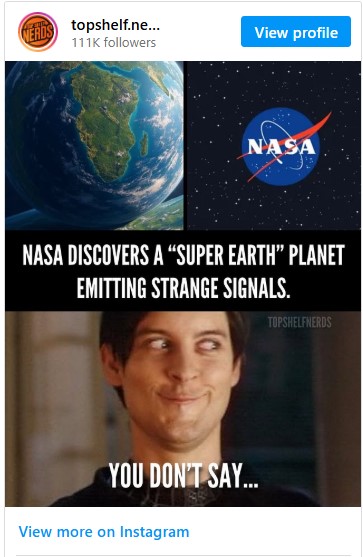
Indeed, claims that scientists discovered a new exoplanet using TESS are mostly true. The discovery was made by a research team based at the Oukaimeden Observatory in Morocco who "validated TOI-1846b using TESS and multicolor ground-based photometric data, high-resolution imaging, and spectroscopic observations," according to a paper published by the discovery team.
However, there's some important context to understand.
For instance, the reports of signals described as "mysterious" or "strange" by users on social media and tabloids like the Daily Mail were embellished to entice readers, which is why we've rated this claim as mostly true. Claims suggesting that the discovery of TOI-1846b can be attributed to anything otherworldly, unfamiliar or otherwise "strange" emanating from the exoplanet were inaccurate.
Rather, the scientists in question engaged a method commonly used for detecting exoplanets by measuring transit signals or a "dip" in starlight captured by scientific instruments due to a planet passing in front of the star it orbits. A NASA spokesperson explained to Snopes via email:
When a planet passes directly between us and a star, the planet blocks some of the starlight from reaching us. For a brief period of time, the star's light gets dimmer from our viewpoint. That small change can alert astronomers to the presence of a planet around a distant star. This change is known as a transit signal, and it is one of the main methods scientists use to discover exoplanets, or planets outside our solar system
"TESS' mission was designed to discover thousands of exoplanets this way," NASA told Snopes. "Using data from TESS, as the authors of this study did, scientists have found planets ranging from small, rocky worlds to giant planets."
According to the paper laying out the research behind the discovery, "TOI-1846b is a super-Earth-sized planet, with a radius of approximately 1.8R⊕, placing it within the intriguing radius valley area of exoplanet sizes."
NASA defined "super-Earth" as "unlike anything in our solar system, these are 2 to 10 times the mass of Earth, but smaller than Neptune, and can be made of gas, rock or a combination of both." Researchers said their discovery "most probably has a water-rich bulk composition based on its radius."
Further, NASA explained the "radius valley" as "what seems to be a strange gap in planet sizes" that could impact the type of terrain the planet features, such as "rocky super-Earths, and the more substantial, gasrich mini-Neptunes," according to the research paper. NASA also noted it "will require a far better understanding of how planetary systems form" to fully explain said radius valley.
According to a report about the discovery from the science website Earth.com, "the size and weight combination" on TOI-1846b "gives it a density lighter than solid rock but heavier than planets with thick, gassy envelopes."
Additionally, the report from the discovery team stated, "Such planets are relatively rare, and their study can provide vital clues about planet formation and evolution processes."
The report also stated that M dwarf stars, such as the one TOI-1846b orbits, are "promising candidates for the search of small, temperate exoplanets using transit methods" because the "transit signal is significantly more pronounced than that of similar planets orbiting Sun-like stars, making such planets easier to detect and characterize."
According to NASA, exoplanets are divided into four categories: "Gas giant, Neptunian, super-Earth, and terrestrial." NASA's Exoplanet Archive stated there are more than 6,000 confirmed exoplanets, with 725 of those confirmed by TESS since the satellite launched in April 2018.
The Exoplanet Archive does not currently list TOI-1846b, but a NASA spokesperson said "there may be a small delay in updates" to the site.

Sources
Exoplanets - NASA Science. 7 Jun. 2023.
"NASA Discovers a 'super-Earth' with Possible Oceans Orbiting a Nearby Red Dwarf Star." Earth.Com. Accessed 16 Jul. 2025.
NASA Exoplanet Archive. Accessed 16 Jul. 2025.
Nowakowski, Tomasz and Phys.org. Astronomers Discover a Super-Earth Exoplanet Orbiting a Nearby Star. Accessed 16 Jul. 2025.
TESS (Transiting Exoplanet Survey Satellite) - NASA Science. 22 Apr. 2025.
What's a Transit? - NASA Science. 27 Apr. 2020.